

The beloved late-night show is approaching the end of a long era—marked by jokes, gratitude, and palpable frustration. The final week has turned into a public debate about money, politics, and the future of comedy on traditional television.
A star-studded farewell
Stephen Colbert's last episode of The Late Show is set to air on May 21 on CBS. The final week featured appearances from Jon Stewart, Steven Spielberg, David Byrne, and Bruce Springsteen, each offering their own mix of celebration and criticism. Stewart used his time to roast both CBS and Donald Trump, while Springsteen delivered a blistering political critique from Colbert's own stage.
The cancellation controversy
CBS has stated that the decision to end the show was financially motivated. However, many have questioned the timing, as it came shortly after Colbert criticized Paramount's settlement with Trump and amid ongoing merger negotiations between Paramount and Skydance. Colbert expressed surprise at the cancellation, noting that as recently as 2023 the network encouraged him to consider a five-year deal; he ultimately signed for three years. He did not accuse CBS of misleading him, acknowledging that traditional television struggles to monetize in the streaming and YouTube era. Yet he understood why many viewers found the timing suspicious—especially given Paramount's settlement with Trump over 60 Minutes. For him, both things could be true: the business model might genuinely be under pressure, and the timing could still raise legitimate questions.
Jon Stewart's cameo: jokes and jabs
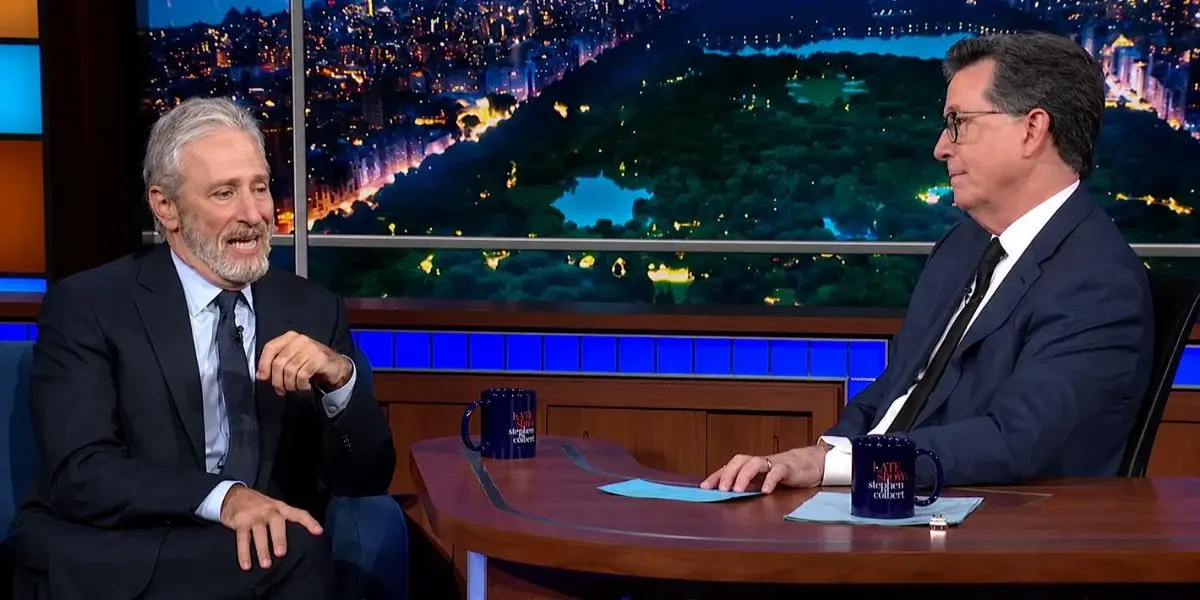
Jon Stewart kicked off his appearance by joking about how Colbert helped him fix his suit jacket backstage, using the story to highlight Colbert's attentiveness as a friend. The conversation quickly turned to CBS. Stewart quipped that the network seemed to have a bizarre strategy: cancel The Late Show, weaken the evening news, and cut back 60 Minutes. "They're deliberately tanking to get a good draft pick," Stewart said. Colbert kept his response low-key, saying he enjoyed spending his final episodes with friends, the audience, the band, and his crew. When Stewart asked how Colbert remained so calm, Colbert credited Stewart with teaching him how to work under pressure.
Stewart also recalled his own experience of ending a late-night show. He shared that David Letterman was his last guest and gave him a piece of advice: "Don't confuse cancellation with failure." Then Stewart added with a laugh that Letterman immediately joked that in his own case, cancellation was indeed a failure. Stewart praised Colbert's production team for supporting the most outlandish ideas over the years, such as requesting a secret room, a moving bookshelf, and alpacas for a sketch—and somehow making it happen.
Political satire and Trump criticism
Colbert said he originally did not plan for The Late Show to be so politically charged. In an interview with the New York Times, he revealed that CBS initially advised him against delving too heavily into news and politics. He himself wanted to avoid the increasingly aggressive public discourse. That changed during the 2016 election campaign. Colbert leaned into political satire, especially criticism of Trump, and the show found its voice. He rejected the idea that it became purely partisan, arguing that comedians naturally oppose authoritarian behavior and that powerful people hate being laughed at. Stewart echoed this sentiment during his visit, saying Colbert's show should not be reduced to pure opposition to Trump. For Stewart, the show was also about joy, craft, friendship, and the daily work of creating something live for an audience.
Bruce Springsteen's pointed critique
Bruce Springsteen went even further. According to Pitchfork, he directly criticized the leadership of CBS and Paramount on Colbert's set. Springsteen said Colbert was losing his show because America "has a president who can't take a joke." He accused powerful media executives of bending to political pressure instead of defending basic creative freedom. His words gave the farewell week a sharper edge. The guests were not just saying goodbye to a host. They were also asking what happens when corporate caution, political pressure, and entertainment collide.
Colbert's legacy and next steps
Colbert's final week has become much more than a nostalgic farewell tour. Stewart brought friendship and mockery, Springsteen open political anger. Colbert himself tried to balance gratitude and skepticism, saying he wants to end his years at CBS with thankfulness rather than bitterness. He also admitted he does not yet know what comes next. He is currently working on a script related to a new Lord of the Rings film and has spoken about how much he loves live audiences, interviews, podcasts, and comedy. But the show has consumed most of his thoughts for years, and he says he needs time before deciding his next move.
The final chapter is still being written. The last episode airs tonight—after a week in which Colbert's friends have made one thing clear: no matter how CBS frames the decision, the people around him are not treating the end of The Late Show as a quiet business adjustment. The era of Stephen Colbert's late-night tenure ends amid questions about the future of political comedy on network television, the influence of corporate media, and the relationship between entertainment and political power. As Colbert steps away, the void he leaves behind is not just in the schedule but in the cultural conversation—a space where satire and sincerity coexisted, and where laughter was a weapon against absurdity. Whether another host can fill that role remains an open question, but Colbert's mark on the genre is indelible. For now, the audience watches as the lights dim on one of the most defining shows of the past decade.
Source: Dagens Deutschland News