

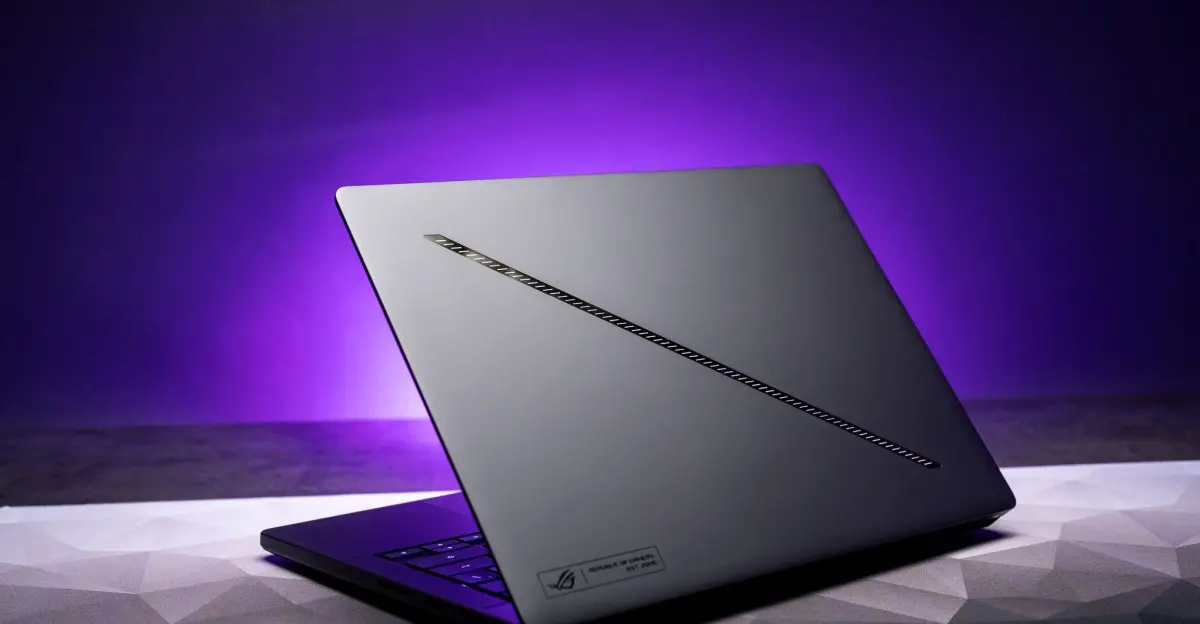
The Asus ROG Zephyrus G14 has been a standout laptop since its debut in 2020, carving out a niche as a compact device that can handle both demanding work tasks and serious gaming. Over the years, it has received design refreshes, chip upgrades, and even a special edition, all while maintaining its reputation as a versatile powerhouse. In 2026, Asus introduces a major change: switching from AMD processors to Intel's new Panther Lake CPUs, along with highly requested features like a full-size SD card slot and Thunderbolt 4 support. But with prices skyrocketing due to global memory shortages and component costs, the question becomes whether the improvements justify the premium.
A Familiar Design with Subtle Refinements
The 2026 G14 retains the same sleek, minimalist chassis introduced with the 2024 redesign. It measures just 0.63 inches at its thinnest point and weighs 3.48 pounds, making it nearly identical in size and weight to a 14-inch MacBook Pro. The exterior features the signature animated slash lighting on the lid, now with more LED segments for smoother animations. The bottom vents have switched from rectangular slots to circular holes, which adds a subtle visual twist. Overall, the build quality remains excellent—aluminum construction gives it a premium feel, and the matte finish resists fingerprints well.
One of the biggest creature comforts is the addition of a full-size SD card slot, a move that will please photographers and videographers who previously had to rely on microSD adapters or external readers. The port selection is otherwise generous: two USB-C ports (one Thunderbolt 4, one USB 3.2 Gen 2), two USB-A 3.2 Gen 2 ports, HDMI 2.1, a 3.5mm combo jack, and Asus’s proprietary reversible power connector. Notably, the Thunderbolt 4 port replaces the older USB4 standard, offering faster data transfer and greater compatibility with docks and eGPUs.
Display and Audio: A Multimedia Delight
The 14-inch OLED panel remains one of the best in its class, with a resolution of 2880 x 1800 and a 120Hz refresh rate. It covers the DCI-P3 color gamut and achieves up to 500 nits in SDR mode, with HDR peak brightness reaching 1,100 nits. This makes it excellent for photo editing, watching HDR content, and gaming with vibrant colors and deep blacks. The screen is also factory calibrated, so color accuracy is spot-on out of the box.
Asus has also improved the audio system. The G14 now packs six speakers (two tweeters, two woofers, and two force-cancelling drivers) that deliver rich, full sound with a surprising amount of stereo separation. It’s easily the best-sounding Windows laptop in this size class, rivaling the MacBook Pro’s audio quality. Whether you’re listening to music or watching movies, the speakers provide an immersive experience without requiring headphones.
Performance: Work and Gaming Without Compromise
Under the hood, the 2026 G14 is powered by Intel’s Core Ultra 9 386H, a 16-core Panther Lake processor paired with Nvidia’s GeForce RTX 5070 Ti Laptop GPU. The review unit came with 32GB of soldered LPDDR5X RAM and a 1TB NVMe SSD. In everyday use, the laptop flies. Opening dozens of Chrome tabs, running Slack, Spotify, and Lightroom simultaneously feels snappy, even on battery. The Panther Lake chip is particularly efficient, allowing the G14 to maintain strong performance when unplugged—a rarity among gaming laptops.
For creative work, the G14 handles 50-megapixel RAW photo editing in Adobe Lightroom Classic without breaking a sweat. Export times are respectable, and the laptop stays cool and quiet during light editing sessions. Video editing in Premiere Pro also benefits from the dedicated GPU, though render times are slightly longer than a comparably priced MacBook Pro M5 Max. Still, for a 14-inch Windows laptop, the performance is impressive.
Gaming is where the G14 truly shines. In Battlefield 6, it averages 65–70 fps at native resolution with high settings, no DLSS needed. Helldivers 2 runs at 80–90 fps under the same conditions, and Marathon hovers around 70 fps with DLSS set to Quality. The GPU can be boosted via Armoury Crate’s Turbo mode, which overclocks the GPU by 50MHz and increases TGP up to 130W, gaining an extra 5–10 fps at the cost of louder fan noise. The keyboard deck stays comfortable even during long gaming sessions, though the bottom gets quite hot—a common trade-off in thin gaming laptops.
Battery Life: A Game Changer
The biggest improvement over previous generations is battery life. Thanks to Intel’s Panther Lake architecture, the 73Wh battery can last over 17 hours in video playback tests. In real-world mixed use (browsing, Slack, music streaming), the G14 consistently delivers about 10 hours on a single charge. That’s enough to get through a full workday without reaching for the power adapter. Even when doing GPU-intensive tasks like photo editing, you can expect 5–6 hours. This level of endurance is unheard of in most gaming laptops and positions the G14 as a true all-day companion.
Keyboard, Trackpad, and Webcam
The keyboard remains one of the best among Windows ultraportables. Key travel is deep and responsive, with a satisfying tactile feel that outclasses most competitors except for Lenovo ThinkPads. The large mechanical trackpad is smooth and clickable, though it doesn’t register clicks in the top corners (like Apple’s force touch trackpad does). That’s a minor complaint; most gamers will use a mouse anyway. The 1080p IR webcam is adequate for video calls but struggles in low light—grainy images are common, and the camera lacks a privacy shutter. The built-in fingerprint reader is absent, but Windows Hello facial recognition works reliably.
The Price Problem
All these positives come with a significant downside: the price. The 2026 Intel-based G14 starts at $3,450 for the base configuration (16GB RAM, 1TB SSD, RTX 5070 Ti). The review unit with 32GB RAM costs $3,600. That’s a $1,000 premium over the last-gen AMD model with the same GPU and storage. The previous generation (2025) with a Ryzen AI 9 HX 370, RTX 5070 Ti, 16GB RAM, and 1TB SSD can still be found for under $2,500. Asus is keeping the older AMD models around, but prices could rise as component shortages persist.
To put it in perspective, the $3,600 G14 competes directly with a 14-inch MacBook Pro M5 Max, which offers better CPU performance and longer battery life—but cannot game. Alternatively, you could buy a base MacBook Pro M5 and a PlayStation 5 Pro or Steam Deck for less money. The G14’s value proposition has eroded; it’s no longer a budget-friendly option but rather a luxury device for those who want everything in one package.
Alternatives and Verdict
If you’re willing to trade battery life for raw performance, the Asus Strix Scar 16 offers a larger 240Hz Mini LED display and faster frame rates for a similar price. The Razer Blade 16 provides a more premium aesthetic but costs even more. Meanwhile, the Framework Laptop 16 offers upgradability but lacks the G14’s polish. For most users, the previous-generation AMD G14 is still the smarter buy—it’s nearly as fast, costs considerably less, and shares the same excellent design. The 2026 Intel G14 is an exceptional machine, but its price makes it hard to recommend unless you must have the best battery life and the full-size SD card slot.
Source: The Verge News