
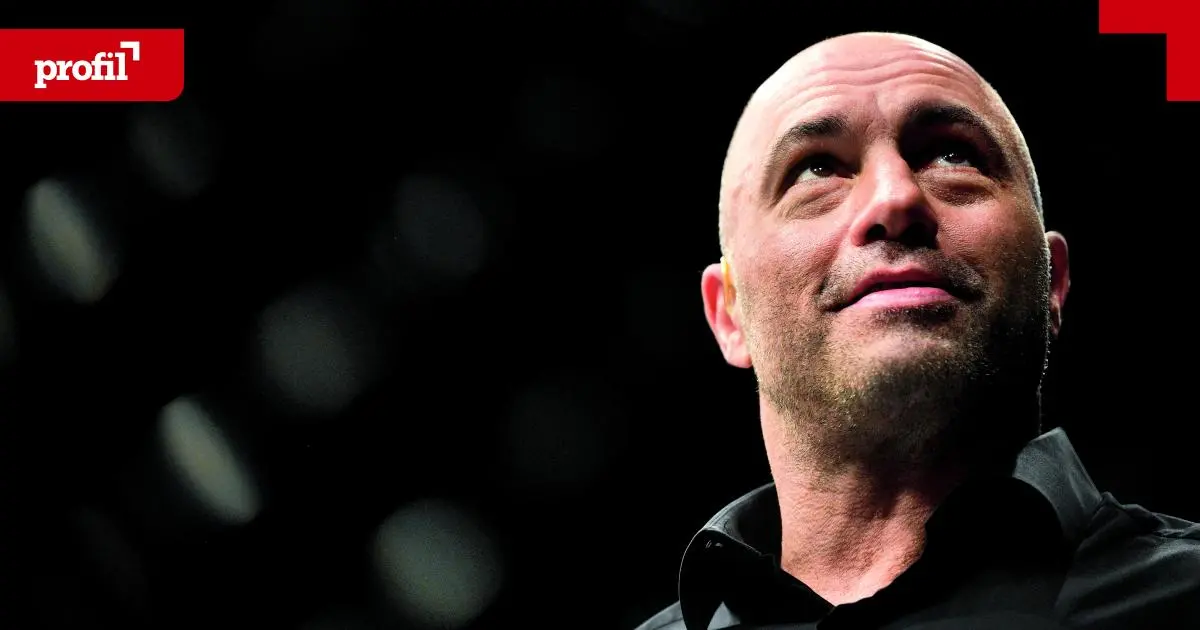
Unshaven and dressed in a gray hoodie, Joe Rogan stands in his garden recording a selfie video on his mobile phone. "Because of the controversy that's going on right now," he begins, before thanking viewers for all the "love" they have shown him. Then Rogan spends ten minutes explaining what he does: inviting people onto his podcast, "The Joe Rogan Experience," because he simply wants to hear their opinions. Sometimes he invites recognized medical experts, such as epidemiologist Michael Osterholm, who serves on President Joe Biden's Covid-19 advisory panel, and other times people who hold views that "deviate from the mainstream narrative." This is where the controversy begins.
The seemingly good-natured and harmless Joe Rogan has become the center of a debate on how to combat dangerous misinformation. His podcast, "The Joe Rogan Experience," has more downloads on the audio platform Spotify than any other. Because some guests in the show have made false claims about the coronavirus pandemic and especially about vaccination, 270 doctors and healthcare professionals wrote an open letter accusing Rogan of being a "threat to public health." Rock stars Neil Young and Joni Mitchell joined the protest and had their works removed from Spotify because the platform operators refused to remove Rogan from the program.
The reach of "The Joe Rogan Experience" is enormous. The podcast records 190 million downloads per month, plus up to ten million views of video versions on YouTube, and Rogan has another 14.3 million followers on Instagram.
The Unlikely Rise of a Martial Artist
Joseph James Rogan was born on August 11, 1967, in the U.S. state of New Jersey. It cannot be said that he was given much in life. His father, a policeman, allegedly was occasionally violent at home, and his parents separated when Joe was five years old. From then on, he lived with his mother and later with his stepfather, whom he once described as a "hippie," first in California and later in Massachusetts. In an interview with Rolling Stone magazine, Rogan said that as a child he was insecure and afraid of suddenly having no friends. In high school, he discovered martial arts and proved to be a talent. He became U.S. champion in Taekwondo.
His friends in the martial arts scene found Rogan's jokes and imitations of other people funny and encouraged him to try stand-up comedy. Rogan performed in comedy clubs and supported himself with odd jobs. He moved to Los Angeles and landed a role in a sitcom.
At that point, Joe Rogan was miles away from celebrity status—and at least as far from influencing what millions of people believe is true or false. His career would take a few more surprising turns before he would interview some of the most important people in the country.
In 1997, Rogan took a job he enjoyed: he became an interviewer for fights in the martial arts organization "Ultimate Fighting Championship" (UFC). Two opponents fight each other in a cage, and at that time, almost anything was allowed. When the fights were banned, the organizers created a set of rules that reduced the risk of injury. As a legal sport, UFC matches quickly became blockbusters, watched by millions of viewers on pay-TV channels—and Rogan became one of the stars of the scene. The predominantly male audience loved his commentary. A sample: "He has a cut as big as a goat's vagina." Joe Rogan had made it into the league of TV celebrities. Soon he hosted the reality game show "Fear Factor," continued performing as a comedian, and in 2009 he created his own podcast, "The Joe Rogan Experience."
The Podcast Phenomenon
Rogan started with modest equipment in a home studio. The first sponsor he landed was a manufacturer of sex toys. Guests were mostly Rogan's friends from the comedy scene, with whom he would discuss various topics. As the fan base grew, top-tier celebrities came into the studio: Tesla CEO Elon Musk, Twitter co-founder Jack Dorsey, pop star Miley Cyrus, rapper Kanye West, and many others.
In the podcast genre, few can currently match Rogan. Being invited onto his "Experience" means enormous publicity, and when the platform Spotify signed an exclusive deal with him last year, the reported fee was 100 million dollars. Joe Rogan has long become one of the most influential opinion makers in the United States.
Does Joe Rogan Have a Political Agenda?
His career path suggests that Joe Rogan is not an intellectual and does not want to be one. On the contrary, especially now that he is heavily criticized, he retreats to his role as a mere questioner. He simply invites people who hold interesting opinions. The list of more than 700 guests over the years hardly allows for ideological conclusions. Rogan has invited right-wing radio firebrand Alex Jones as well as left-leaning U.S. Senator Bernie Sanders.
After Rogan gave an endorsement for Sanders following their conversation during the 2020 primary campaign, Sanders' campaign team rushed to publicize this scoop. Calling Rogan a right-winger would therefore be a mistake. What matters is how the podcast guru treats his guests. He very authentically plays the slightly naive average person who wants to form an opinion. "I am not a doctor or a scientist," says Rogan. "I am someone who sits down and talks with them."
However, when the guest is a conspiracy theorist like the American virologist and vaccine skeptic Robert Malone, Rogan's conversational style has a questionable effect: what Malone claims remains largely uncontradicted. Malone indulges in wild visions of the population being "hypnotized" through a "mass education psychosis" (a term that sounds scientific but is not) into believing that vaccines are effective. He suggests that a deal between the government, big pharmaceutical companies, and mainstream media ensures that information about vaccine injuries cannot be made public. Rogan sits opposite Malone and often does not interrupt him for minutes. Rogan does not see it as his job to gather all the essential information before an interview to be able to question or refute the statements of a guest.
This is the big difference from interviews conducted in "mainstream media." And it may sound paradoxical, but this accounts for much of the success of people like Rogan. His audience hates the know-it-all attitude of a New York Times that debunks Malone's adventurous theories point by point. Rogan himself sometimes seems like a naive child when, for example, he explains in a podcast why he long believed that the moon landing never happened, but has now come to the conclusion that he was mistaken. About former U.S. presidential candidate Hillary Clinton, he says: "I don't know if she killed people. But I'm afraid she might have killed some." How can a man with a below-average judgment be incredibly popular as an interviewer?
The appeal of "The Joe Rogan Experience" lies in the subversive attitude of being able to believe everything. No matter how bizarre the theories of Rogan's guests, before his microphone there is absolute equality between facts and fantasies, reality and nonsense. Rogan claims he wants to "know what the facts are," but his approach is so far removed that his listeners can trust that conspiracy theories also remain unchallenged.
In one of his episodes, Rogan had comedian Bill Burr as a guest, and Rogan wanted to discuss whether one should wear a mask on the street because of the pandemic. Rogan is against it. Burr becomes annoyed: "Don't start with that now!" When Rogan doesn't let go, Burr admonishes him: "I don't have a doctorate in medicine and neither do you, and we're sitting here smoking cigars and acting like we know better than the health authorities?"
Burr hits the crucial point. It is futile to expect serious answers to factual questions from the podcast "The Joe Rogan Experience." In the end, the host retreats to the position that he does not know what is true. And yet millions of people follow Rogan's podcasts, which sometimes last up to three hours.
Matthew Rosenberg, a reporter for the New York Times, wrote a suggestion for journalists on Twitter about the Rogan phenomenon: "We in the media should spend more time thinking about why so many people trust him instead of us."
Should "The Joe Rogan Experience" Be Taken Off the Air?
The concern of the 270 doctors and health experts who signed a public appeal to persuade Spotify not to allow podcast episodes like the one with Robert Malone so easily is understandable. While the responsible and competent institutions strive to educate the population, people like Malone, with the help of Joe Rogan, sabotage all information campaigns.
However, how to combat the spread of misinformation is not easy to answer. Rock stars Neil Young, David Crosby, Stephen Stills, Graham Nash, and Joni Mitchell want to boycott Spotify until "The Joe Rogan Experience" disappears from the platform. There is a certain irony when musicians from an era in which the consumption of illegal drugs was elevated to a lifestyle ("Sex and Drugs & Rock'n'Roll") demand a ban on health-endangering statements.
But they are not the only ones who believe that only bans can fight fake news. However, anyone who holds this opinion should listen again to the episode of "The Joe Rogan Experience" with Robert Malone. In it, the two discuss extensively that Malone has already been banned on the platforms LinkedIn and Twitter. For the doctor, who presents himself as a vilified outlaw of the scientific community, such measures are an award and proof of how much the coalition of government, Big Pharma, and Big Media—which he fantasizes about—fears his supposed findings. And for his followers—and loyal Rogan listeners—the same applies.
Whether they actually believe everything that a Malone or other podcast guests say is far from certain. Listening to wild theories that are considered dangerous is also a form of entertainment. Moreover, exclusion (or the illusion of it) creates a sense of community. The vast majority of Joe Rogan fans are men who also like to hear their buddy Joe ranting about how "soon curfews will be imposed" on heterosexual white men. "I'm not joking," says Rogan.
Comedian Jon Stewart last week called on Neil Young and all others boycotting Spotify because of Rogan to come back. "Don't go away. Don't give up. Don't censor. Engage!"
Source: Profil News