

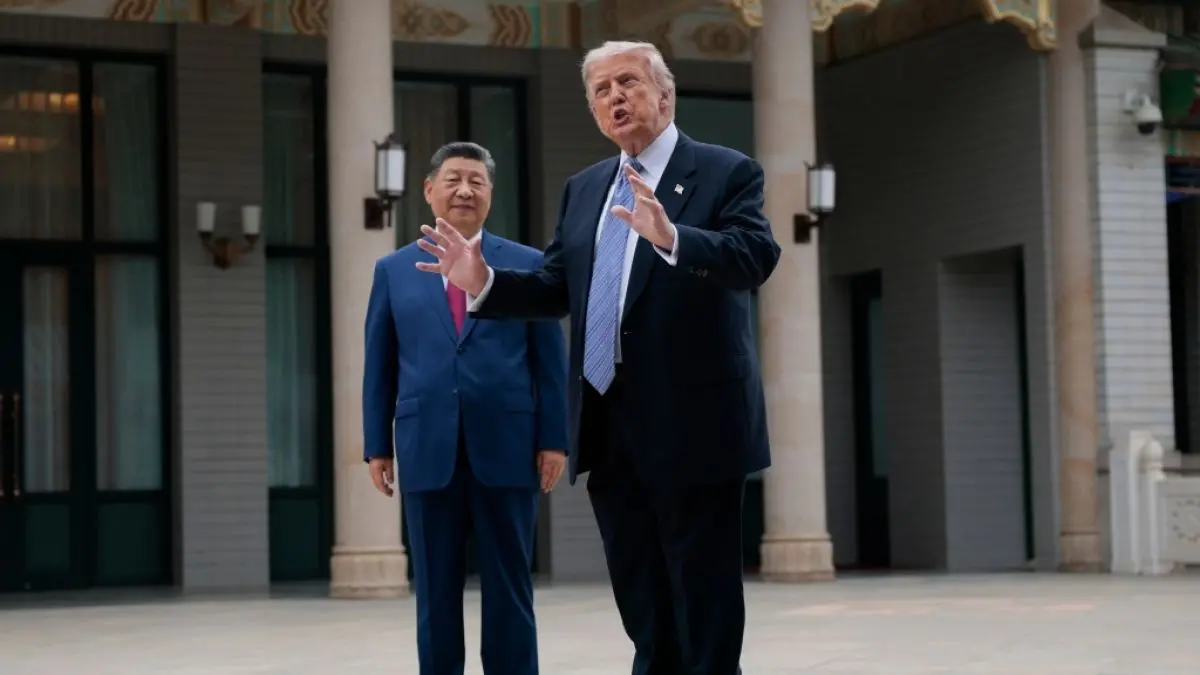
US President Donald Trump has once again stirred controversy with unusual and effusive praise for Chinese President Xi Jinping. In an interview with Fox News host Sean Hannity aired Thursday night, Trump described Xi as 'like out of a picture book' for a Chinese leader, adding that 'in Hollywood, you couldn't find a guy who would play that role better.' The comments quickly went viral, drawing sharp criticism and accusations of racism across social media platforms.
Key Facts at a Glance
- Event: Trump praised Xi Jinping's physical appearance and leadership style during a Fox News interview on May 15, 2026.
- Key Quotes: Trump called Xi 'very tall, especially for this country' and said he is 'central casting' for a Chinese leader.
- Reaction: Critics accused Trump of racial stereotyping, while supporters claimed he was simply acknowledging Xi's stature.
- Context: This is not the first time Trump has commented on a foreign leader's body; he previously praised Kim Jong Un's 'beautiful' letters and called him 'short and fat' in another context.
The Interview and Its Fallout
During the interview, Trump elaborated on Xi's attributes. 'He’s tall, very tall, and especially for this country, because they tend to be a bit smaller,' Trump said. The phrase 'this country' was widely interpreted as a reference to China, leading to immediate backlash from Asian American groups and international observers. Trump also stated that Xi is 'actually a warm-hearted person, but completely focused on business — no games.' He noted that with Xi, there is no small talk about weather or stars — only substantive matters. Trump acknowledged that his positive comments about certain leaders often draw criticism, but defended his stance: 'They always criticize me when I say good things about certain leaders. But Xi leads almost 1.5 billion people and commands respect. What am I supposed to do?'
The president’s use of 'central casting' — a term derived from a Hollywood agency founded in 1925 that supplied extras for films — became a focal point of the controversy. While Trump has used the phrase before to describe other figures, applying it to a foreign leader in the context of ethnicity and geography was perceived by many as reductive and offensive.
Social Media Erupts
On X (formerly Twitter), reactions ranged from disbelief to outright condemnation. One user wrote, 'Make racist comments great again. Every damn day.' Another commented, 'His stupidity is breathtaking. How the hell did we end up here?' Multiple commentators noted Trump’s pattern of focusing on male bodies. 'Trump talks about men’s bodies a lot lately. Just saying,' observed a user. Another expressed sympathy for the interviewers who have to maintain a straight face while Trump rambles on about physical features.
The hashtag TrumpRacism trended briefly, with many drawing parallels to earlier remarks about immigrants and other world leaders. Critics pointed out that the interview came just days after Trump’s administration announced new tariffs on Chinese goods, highlighting the contradictory nature of his China policy — simultaneously adversarial and fawning.
Historical Context: Trump’s Track Record with Foreign Leaders
This is not the first time Trump has made headlines for personal remarks about foreign heads of state. During his first term, he frequently praised Chinese President Xi, referring to him as a 'great leader' and even defending his decision to remove Hong Kong's special status. Trump also maintained a cordial relationship with North Korean leader Kim Jong Un, calling their exchanges 'love letters' and marveling at Kim's youthful appearance. However, Trump also mocked Kim as 'short and fat' in 2017 before meeting him. Analysts note a pattern: Trump often focuses on physical traits — height, weight, build — as proxies for power and competence. This tendency reflects a broader worldview that privileges masculine, authoritarian aesthetics.
In 2020, Trump called Xi a 'brilliant man' and expressed admiration for his handling of the pandemic, despite later blaming China for the virus. The current comments fit a long-standing narrative of Trump treating Xi as a model strongman, consistent with his praise for Vladimir Putin, Rodrigo Duterte, and other leaders who consolidate power.
Racism Accusations and Asian American Responses
The mention of 'especially for this country' triggered accusations of racial stereotyping, reinforcing the idea that Asian people are uniformly shorter — a trope rooted in colonial and imperialist depictions. Asian American advocacy groups quickly condemned the remarks. 'Reducing a person’s leadership qualities to their height relative to a racial stereotype is both ignorant and damaging,' said a spokesperson for the Asian American Legal Defense and Education Fund. 'This kind of language perpetuates harmful myths and feeds into xenophobia.'
Some defenders argued that Trump was simply stating a fact about average height differences, noting that the average height in China is about 5'7" for men, while Xi is reportedly around 5'11". Yet critics counter that singling out Xi's height in such a context was unnecessary and problematic, especially given Trump’s history of using physical descriptors to demean opponents. The controversy also revived debates about the 'model minority' myth and the fine line between admiration and objectification.
Media and Political Reactions
Fox News faced criticism for airing the interview without challenging Trump’s characterization. Some conservative commentators, however, defended Trump, claiming he was simply being diplomatic. 'He’s trying to build a relationship with a key global partner,' said a Fox News contributor. 'Why can’t we just take a compliment?' Meanwhile, Democratic lawmakers seized the moment to highlight Trump’s erratic diplomacy. Senator Elizabeth Warren tweeted, 'America deserves a president who can discuss foreign policy without resembling a casting agent for an outdated Hollywood film.'
Chinese state media initially did not report the interview, but netizens on Chinese social media platforms like Weibo engaged in heated discussions. Some expressed embarrassment, while others saw it as a sign of respect from a superpower leader. 'It’s weird but at least he doesn’t insult us like he does others,' wrote one user. The Chinese foreign ministry declined to comment.
Broader Implications for US-China Relations
The interview occurred against a backdrop of escalating trade tensions. Just a week earlier, Trump announced a 25% tariff on Chinese electric vehicles, accusing Beijing of unfair trade practices. Analysts suggest that Trump’s personal praise for Xi may be an attempt to separate the leader from the system — a common strategy in his dealings with authoritarian regimes. 'Trump believes in personal relationships,' said Dr. Emily Yang, a political scientist at Georgetown University. 'He thinks if he can charm Xi, he can get better deals. But this overlooks the structural realities of Chinese governance.'
Historically, US presidents have maintained a formal tone when discussing world leaders, but Trump’s informal, body-focused commentary breaks with diplomatic norms. Whether this approach yields results remains unclear. Xi, known for his disciplined and image-conscious persona, has rarely reciprocated with intimate praise for Trump.
Additional Context: Trump’s History with Male Bodies
Observers have noted Trump’s unusual frequency in commenting on male figures. In 2024, he remarked that former Vice President Mike Pence 'looked like a little boy' and criticized his physical strength. In 2023, he said Robert De Niro was a 'wreck' and 'looks terrible.' His obsession with body language and physical appearance extends to political rivals, whom he often mocks for their height, weight, or facial features. This pattern has led some psychologists to suggest that Trump subconsciously equates physical size with dominance, a trait common among narcissistic leaders.
The Xi incident also echoes Trump’s infamous 'grab them by the pussy' comment, highlighting a tendency to sexualize or objectify both men and women in public discourse. While Trump’s praise for Xi was framed as admiration, the underlying objectification of his physicality raised eyebrows even among allies.
The Role of Fox News and Conservative Media
Fox News has been Trump’s preferred platform for unfiltered messaging. Hannity, a longtime Trump confidant, did not push back on the remarks and allowed Trump to reflect on his leadership philosophy. The interview also touched on other topics, including immigration and the economy, but the Xi segment dominated headlines. Critics argue that by giving Trump a platform to air such views without commentary, Fox News legitimizes racially charged language. Others contend that the network’s audience largely accepts Trump’s style as authentic and refreshing.
Conservative media analysts have noted that Trump’s base tends to approve of his bluntness, even when it veers into controversy. A recent poll by Pew Research indicated that 63% of Republican voters believe Trump 'tells it like it is' and that such directness is beneficial in international relations.
Conclusion? Not Quite — Ending with Analysis
The episode underscores a recurring theme in Trump’s communication style: the blurring line between diplomacy and personal, often awkwardly physical, admiration. As US-China relations continue to be marked by both competition and interdependence, Trump’s language may either help build rapport or deepen misunderstandings. For now, the global audience is left debating whether the president’s compliments are genuine or another form of provocation.
Source: News.de News