

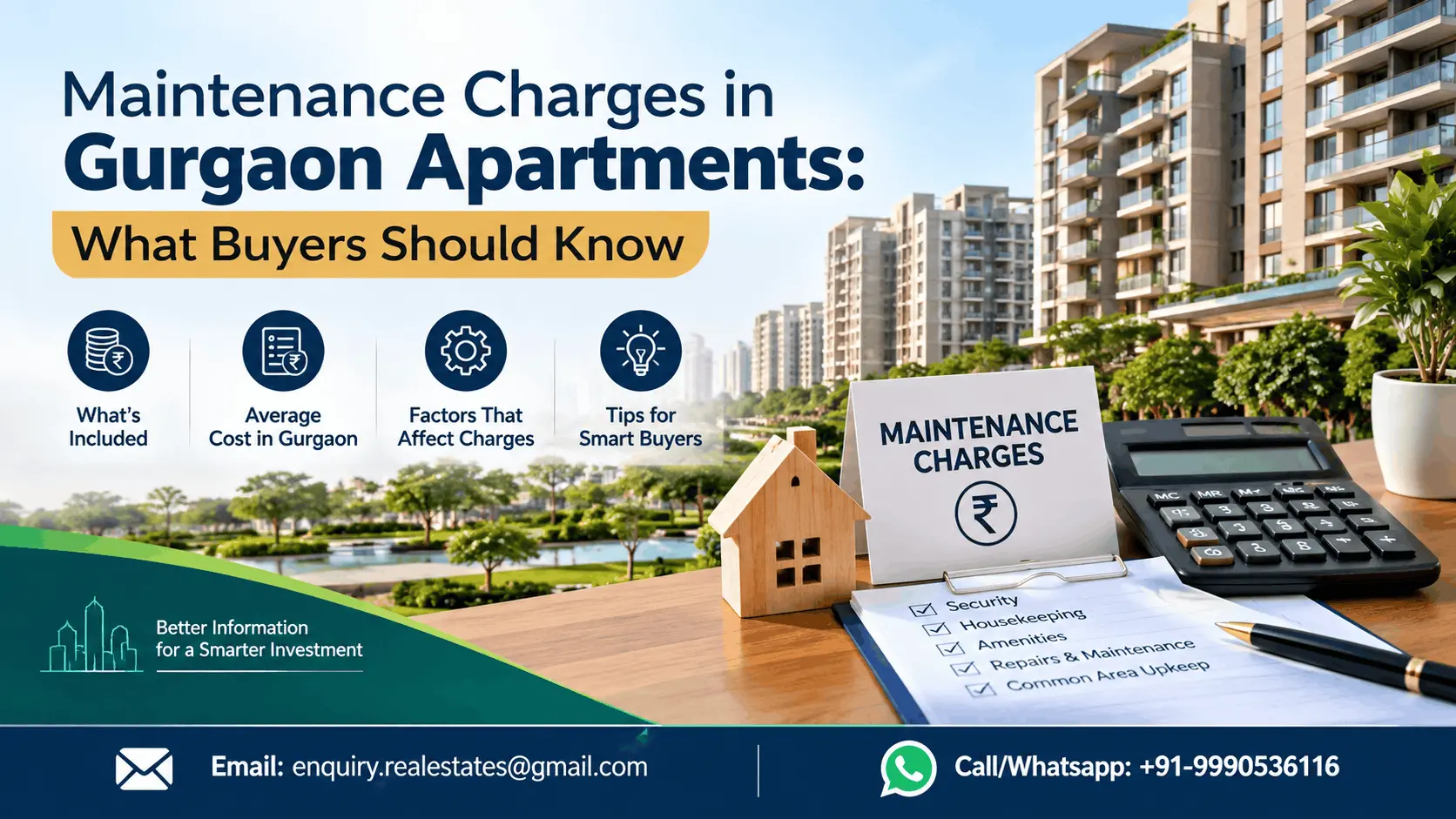
Navigating the real estate ecosystem in Millennium City requires looking beyond the initial booking amount and agreement price. When evaluating a prospective condominium, whether an established luxury community or an upcoming development such as an Ireo New Project, recurring operational expenses play a pivotal role in long-term affordability. Among these recurring expenses, Ireo New Project Gurgaon buyers quickly discover that monthly upkeep costs represent a significant recurring commitment.
Understanding the mechanics of maintenance charges in Gurgaon apartments allows buyers to budget accurately, evaluate developer claims, and avoid unwelcome financial surprises after moving into their new home. This comprehensive guide breaks down common area maintenance fees, legal regulations under the Haryana Real Estate Regulatory Authority, tax implications, and micro-market cost benchmarks across Gurugram.
Navigating Maintenance Charges in Gurgaon Apartments
Decoding Society Upkeep: What Are Maintenance Charges?
In modern high-rise gated communities, maintenance charges represent the collective pool of funds collected from unit owners to preserve, repair, and operate shared infrastructure. Unlike standalone houses where home maintenance is managed individually, multi-story apartments rely on continuous central facility management.
These fees ensure that common areas remain operational, secure, clean, and aesthetically appealing. They cover everything from round-the-clock security personnel and elevator maintenance to multi-tier water filtration, landscaping, and clubhouse operations.
The Core Components of Condominium Maintenance Bills
To understand where your monthly payment goes, it helps to examine the individual line items that form a typical facility management bill in Gurgaon:
1. Common Area Maintenance (CAM)
CAM forms the baseline of your monthly bill. It covers the operational expenditures required to run shared facilities across the residential complex.
-
Security Infrastructure: Salaries for security guards, CCTV surveillance maintenance, boom barrier operations, and digital visitor management applications.
-
Housekeeping & Sanitation: Daily cleaning of lobbies, floor corridors, staircases, basements, and waste management systems.
-
Horticulture & Landscaping: Upkeep of central green lawns, peripheral trees, potted plants, and automated irrigation networks.
-
Elevator Maintenance: Annual Maintenance Contracts (AMCs) for high-speed elevators, third-party safety audits, and emergency response services.
-
Common Illumination: Electricity consumed by streetlights, basement lighting, staircase emergency lamps, and ornamental landscape lights.
2. Power Backup & Diesel Generator (DG) Charges
Given historical power grid fluctuations during peak summer months across Northern India, dual-source power systems are standard in Gurgaon residential projects.
-
Fixed DG Load Charge: A monthly fee based on the sanctioned power backup capacity (measured in kilovolt-amperes) reserved for your apartment, regardless of whether diesel generators run.
-
Variable DG Consumption Charge: Billed on actual units of electricity consumed while the project operates on generator power during main grid outages.
3. Water Supply & Sewage Treatment
Residential complexes maintain integrated water infrastructure to ensure uninterrupted supply:
-
Water Tanker / Municipal Inflow: Costs incurred for municipal bulk water connections or supplementary private water tankers.
-
Sewage Treatment Plant (STP) Operation: Electricity and chemical treatment costs to recycle greywater for garden irrigation and dual-flush toilet systems.
4. Sinking Fund Allocation
A sinking fund serves as a emergency reserve pool collected by the developer or Resident Welfare Association (RWA). These funds remain untouched during routine upkeep and are reserved exclusively for major structural repairs, building repainting, elevator overhauls, or fire equipment replacements every five to seven years.
5. Interest-Free Maintenance Security (IFMS)
IFMS is a one-time interest-free security deposit collected by the builder at the time of handing over possession. Ranging typically between 50 rupees and 150 rupees per square foot of super built-up area, this capital acts as a financial buffer against non-payment by residents. Upon transfer of society management to the elected RWA, the remaining IFMS corpus must be transferred in full to the RWA bank account.
Calculation Methodologies: Flat-Rate vs Equal-Per-Sq-Ft Models
How maintenance costs are distributed among apartment owners remains a frequent point of discussion in residential welfare meetings. In Haryana, management entities generally adopt one of three primary calculation models:
Method 1: The Per-Square-Foot Allocation Model
Under this traditional approach, the monthly maintenance charge is directly tied to the size of the apartment, calculated using either super built-up area or carpet area.
-
How it works: A rate per square foot per month is established by the facility management agency.
-
Practical Example: In a society charging 4.00 rupees per square foot monthly on super built-up area, a 1,500 square foot 2BHK unit pays 6,000 rupees per month, while a 2,500 square foot 4BHK unit pays 10,000 rupees per month.
-
Rationale: Larger apartments accommodate more occupants on average, consuming a proportionately larger share of shared services and common water resources.
Method 2: The Equal Flat-Rate Model
In this model, every unit owner pays an identical monthly sum regardless of the unit's square footage or layout.
-
Practical Example: Every apartment in the complex pays a flat fee of 5,000 rupees per month.
-
Rationale: Facilities like swimming pools, security gates, gymnasiums, and green parks are equally available to every resident, regardless of whether they live in a compact 2BHK or a expansive penthouse.
Method 3: The Hybrid Split Allocation Model
Widely recognized as the fairest pricing method, the hybrid model divides costs into fixed common amenities and area-linked operational expenses.
-
Fixed Split: Expenses that benefit every resident equally (such as gate security, clubhouse access, and software management fees) are billed as a uniform flat rate per apartment.
-
Variable Split: Expenses tied directly to structural dimensions (such as exterior painting funds, roof repair reserves, and lift usage) are billed on a per-square-foot basis.
Integrated developments such as Ireo Corridors in Sector 67A frequently implement structured hybrid frameworks to ensure equitable cost distribution across diverse layout types.
Comparative Analysis of Maintenance Rates Across Gurgaon Micro-Markets
Maintenance rates in Gurugram vary significantly based on micro-market dynamics, amenity density, developer tier, and land positioning:
| Micro-Market / Zone | Average Monthly CAM Rate (per sq. ft.) | Typical Monthly Bill (3BHK ~2,000 sq. ft.) | Primary Drivers of Upkeep Costs |
|
Golf Course Road & DLF Phase 5 |
₹6.50 – ₹12.00 |
₹13,000 – ₹24,000 |
Ultra-luxury lobbies, multi-tier security, private concierge, extensive spa facilities. |
|
Golf Course Extension Road & Sector 67A |
₹3.50 – ₹5.50 |
₹7,000 – ₹11,000 |
Expansive central greens, large-scale clubhouses like Ireo Corridors Sector 67A, sport courts. |
|
Dwarka Expressway (Sectors 99–113) |
₹2.80 – ₹4.50 |
₹5,600 – ₹9,000 |
Newer high-rise developments, evolving occupancy levels, professional facility management. |
|
New Gurgaon (Sectors 81–95) |
₹2.50 – ₹3.80 |
₹5,000 – ₹7,600 |
High-density modern townships, optimized operational models, competitive pricing. |
|
Sohna Road Corridor |
₹2.50 – ₹4.20 |
₹5,000 – ₹8,400 |
Established gated communities, mature RWAs, balanced amenity structures. |
GST Regulations on Society Maintenance Fees in Haryana
Understanding the tax implications on residential upkeep is critical to avoiding disputes over monthly billing totals. The Ministry of Finance governs Goods and Services Tax (GST) applications on residential housing societies through specific regulatory thresholds:
1. The 7,500 Rupee Exemption Threshold
Under prevailing statutory rules, if the monthly maintenance contribution paid by a flat owner to the RWA does not exceed 7,500 rupees per month, no GST is charged.
2. The Total Amount Billing Rule
If the monthly maintenance fee exceeds 7,500 rupees per month per flat, 18% GST applies to the entire amount, not just the portion exceeding 7,500 rupees.
-
Example A (Below Threshold): If your monthly CAM bill is 6,500 rupees, your GST liability is zero rupees. Total payable: 6,500 rupees.
-
Example B (Above Threshold): If your monthly CAM bill reaches 8,000 rupees, 18% GST applies to the full 8,000 rupees (1,440 rupees GST). Total payable: 9,440 rupees.
3. Exemption Threshold for RWA Turnover
RWAs with an aggregate annual operational turnover of less than 20 lakh rupees are entirely exempt from GST registration and collection, regardless of individual flat charges.
Regulatory Protections under HRERA and Haryana Law
Before the enactment of the Real Estate (Regulation and Development) Act in 2016 and the Haryana Apartment Ownership Act, 1983, homebuyers faced challenges with unannounced facility fee increases and delayed maintenance handovers.
Key Legal Rights for Apartment Buyers in Gurgaon:
-
Disclosure in Allotment Letter: Under HRERA norms, developers must clearly specify the estimated maintenance rate, IFMS deposit amount, and expected handover terms in the initial allotment documentation.
-
Mandatory Handover to RWA: Section 11(4)(g) of the RERA Act obligates the developer to maintain essential services at reasonable rates until the association of allottees (RWA) is registered and takes over facility management.
-
Audited Maintenance Statements: Developers operating facility services prior to RWA handover must maintain separate, audited bank accounts for society maintenance collections and present itemized yearly income and expenditure statements to residents.
-
Transfer of Unutilized Capital: Upon formal handover to the elected RWA, the developer must transfer all accumulated sinking fund balances along with the full IFMS principal amount without unauthorized deductions.
Buyers considering established communities like Ireo The Corridors can review past RWA management records and facility transition documentation during property due diligence.
Hidden Costs & Operational Pitfalls to Audit Before Buying
When inspecting resale properties or evaluating new booking options across Gurgaon, homebuyers should look beyond basic promotional brochures to examine potential operational liabilities:
1. The Dual-Source Power Tariff Gap
While power grid electricity supplied by DHBVN (Dakshin Haryana Bijli Vitran Nigam) costs between 7 rupees and 8 rupees per unit, diesel-generated electricity costs significantly more due to fuel consumption and generator operating efficiency. In societies experiencing frequent summer outages, high power backup usage can double monthly utility bills.
2. Ad-Hoc Capital Assessments
If a residential society maintains an underfunded sinking reserve, major unexpected repairs—such as repairing basement waterproofing leakages, replacing worn elevator cabling, or upgrading firefighting lines—result in sudden lump-sum levies on flat owners.
3. Unsold Inventory Liabilities
In newly delivered developments where the developer holds unsold apartment stock, disputes can arise regarding whether the developer contributes full maintenance fees for those vacant units. HRERA rules explicitly state that developers must pay the full maintenance fee for all unsold, completed units.
4. Commercial vs Residential Billing Rates
In mixed-use developments featuring high-street retail shops on lower levels and residential apartments above, verify that residential unit owners are not subsidizing commercial common area lighting, valet services, or security operations.
Practical Step-by-Step Inspection Checklist for Buyers
Before signing a purchase agreement or paying a earnest deposit, execute this five-step checklist to evaluate maintenance transparency:
Step 1: Examine Maintenance Clauses in Contracts
Verify whether the initial maintenance period (typically 1 to 3 years) is managed by an in-house builder subsidiary or an independent, certified Facility Management Provider (FMP) such as Jones Lang LaSalle (JLL), CBRE, or Knight Frank.
Step 2: Request Historic Utility Statements
Ask the seller or leasing agent for copies of the previous six months of maintenance invoices to verify seasonal variations in DG usage and water charges.
Step 3: Inspect Sinking Reserve Accounts
Confirm that the society maintains an active sinking fund reserve capable of covering future structural maintenance without needing emergency assessments.
Step 4: Clarify Metering Infrastructure
Ensure the unit features smart dual-source prepaid energy meters that separate DHBVN grid power consumption from backup generator usage.
Industry Market Trends & Data (Gurgaon Residential Operations)
Recent facility management data reveals notable trends in residential operational costs across Northern India:
-
Adoption of Tech-Enabled Management Solutions: Over 88% of modern gated communities in Gurgaon now utilize smart resident portals (such as MyGate, Nobrokerhood, or Park+) for automated CAM billing, visitor management, and maintenance ticketing.
-
Transition to Solar Integration: To offset high common area electricity costs, more than 40% of established RWAs along Golf Course Extension Road and Ireo Corridors Gurgaon have installed rooftop solar installations, reducing common lighting expenses by up to 25%.
-
Professionalization of Facility Management: Over 65% of mid-to-luxury housing complexes in Gurugram employ professional international property management agencies rather than self-managing routine operations through local contractors.
Future Outlook: Sustainable Infrastructure & Cost Optimization
As utility rates and labor costs evolve, residential society management across Gurgaon is transforming rapidly:
-
IoT-Enabled Utility Monitoring: Smart sensors installed in STP systems, water storage tanks, and elevator shafts enable predictive maintenance, reducing costly sudden equipment breakdowns.
-
EV Charging Infrastructure Integration: Modern societies are integrating individual EV charging stations into private basements, with billing routed directly through smart apartment meters to prevent common area power theft.
-
Decentralized Waste Management: In compliance with Municipal Corporation of Gurugram (MCG) solid waste guidelines, gated communities are installing automated organic waste converters (OWCs) to process wet waste on-site, lowering municipal waste collection fees.
Key Takeaways for Gurgaon Homebuyers
-
Evaluate Total Ownership Costs: Always calculate the total monthly living cost by adding CAM charges, fixed DG fees, and applicable taxes to your baseline home loan EMI.
-
Verify GST Exemption Rules: Remember that monthly maintenance bills of 7,500 rupees or less per flat are exempt from 18% GST, whereas bills above 7,500 rupees incur 18% GST on the total amount.
-
Audit the IFMS Security Deposit: Confirm the exact IFMS deposit amount collected during booking and ensure proper legal provisions for its transfer to the RWA upon handover.
-
Check Power Backup Tariffs: Inspect dual-metering infrastructure to understand how grid power and backup generator electricity are billed in the complex.
-
Review Legal Disclosures: Ensure all maintenance agreements comply with HRERA guidelines and Haryana Apartment Ownership Act provisions before finalizing property transactions.
Frequently Asked Questions
What are maintenance charges in Gurgaon apartments?
Maintenance charges are recurring monthly or quarterly fees collected from apartment owners to cover the upkeep, security, cleaning, illumination, and operation of shared common areas and amenities.
How are common area maintenance charges calculated in Gurgaon?
Common area maintenance charges are typically calculated on a per-square-foot basis using super built-up area or carpet area, though some societies adopt a flat-rate model or a hybrid model combining fixed and variable charges.
Is GST applicable on residential maintenance charges in Haryana?
Yes, 18% GST applies if the monthly maintenance fee exceeds 7,500 rupees per flat and the society's annual turnover exceeds 20 lakh rupees. GST applies to the entire amount if the threshold is crossed.
What is Interest-Free Maintenance Security (IFMS)?
IFMS is a one-time refundable security deposit collected by the developer at possession to safeguard against non-payment of maintenance bills. It must be transferred to the RWA upon facility handover.
What is included in the Common Area Maintenance (CAM) bill?
CAM covers round-the-clock gate security, housekeeping staff salaries, lift AMCs, street and lobby lighting, lawn landscaping, sewage treatment plant operations, and common area repairs.
Can a developer increase maintenance charges arbitrarily before RWA handover?
No, under HRERA guidelines, developers must provide reasonable, audited maintenance accounts and cannot increase rates arbitrarily without justifying genuine operational cost increases.
Who pays maintenance charges for rented apartments in Gurgaon?
Legally, the owner of the apartment remains responsible to the RWA or developer for maintenance payments, though tenancy agreements often require tenants to reimburse this cost directly.
What happens if an apartment owner refuses to pay maintenance charges?
RWAs can restrict access to common amenities like clubhouses or swimming pools, charge late payment penalties, and take legal recovery action under the Haryana Apartment Ownership Act.
Is power backup electricity included in the base maintenance rate?
No, power backup usually includes a fixed monthly load charge in the CAM bill, while actual diesel generator electricity consumption is billed separately based on units used during power cuts.
What is a sinking fund in society maintenance?
A sinking fund is a long-term reserve fund collected monthly to pay for major future structural repairs, building repainting, equipment replacements, and emergency structural work.
Are vacant or unoccupied apartments exempt from maintenance fees?
No, unoccupied units benefit from ongoing building maintenance, security, and structural preservation, so owners must pay full CAM charges regardless of occupancy.
Does HRERA regulate society maintenance handovers in Gurugram?
Yes, HRERA mandates that developers maintain services at reasonable rates and formally hand over maintenance management along with unspent IFMS funds to the registered RWA.
How do smart electricity meters help control maintenance costs?
Smart dual-source meters automatically switch between municipal power grid billing and generator backup billing, offering transparency and preventing billing discrepancies.
What is the average maintenance cost in Gurgaon luxury apartments?
Maintenance rates in luxury projects along Golf Course Road and Golf Course Extension Road typically range between 3.50 rupees and 12.00 rupees per square foot per month depending on luxury amenities.
How can RWAs reduce monthly maintenance charges for residents?
RWAs can lower operational costs by installing solar energy panels for common illumination, adopting automated waste management systems, and negotiating competitive service contracts.
Final Thoughts
Purchasing a residential property in Gurgaon is a rewarding investment, but long-term satisfaction requires clear foresight into ongoing operational expenditures. By scrutinizing maintenance structures, understanding legal protections under HRERA and Haryana tax laws, and evaluating micro-market cost benchmarks, homebuyers can make confident, financially sound decisions that ensure comfortable condominium living for years to come.